Institute for Political Studies
Institute edition
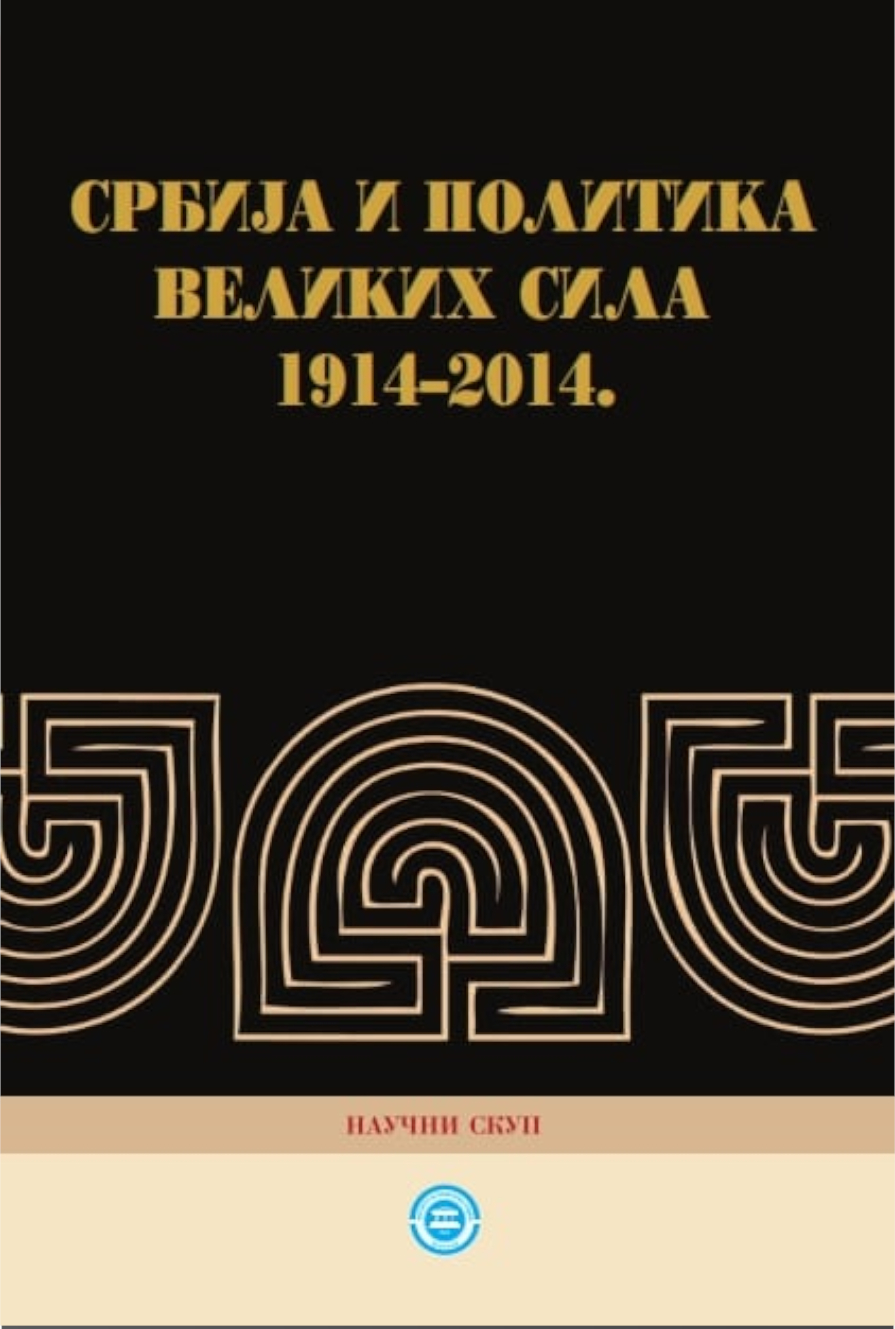
SERBIA AND THE POLITICS OF THE GREAT POWERS 1914-2014.
Đurić, Živojin, Miloš Knežević (eds.). 2014. Serbia and the Politics of the Great Powers. 1914-2014. Belgrade: Institute for Political Studies. ISBN 978-86-7419-275-7
Summary
About the book
Why is it that today, in this troubled hour – amidst the simmering peace at the crisis-ridden end of the transitional era we are experiencing, with undiminished fears for personal and national security, widespread terrorism, and dozens of local and regional conflicts – we remember the first truly global conflict? What is so significant about that conflict that it goes beyond the decimal occasion of marking the centennial of its beginning (1914-2014)? What could be the personal experience of that war, beyond the official instructions for marking the anniversary and what is called the culture of memory or the politics of memory? As if even memory focused on the past can be managed according to the short-term standards of the day?
Although they are similar in the disasters they cause, wars, as mentioned, are very different. And the similarities, as well as the differences, should be remembered. In the modern era, there have been several truly great and brutal wars, but only one has been named – the Great War. That name was given to it out of awe at the height of its duration and then, in times of remembrance and interpretation, until another great and equally terrifying war conflict appeared on the historical horizon. Then the Great War was renamed the First World War. However, when it is said that some of the wars under consideration manifested ruthless greatness in some way, it is understood that only the one fought from 1914 to 1918 was truly the Great War. What was truly great about the Great War? Was it the aforementioned inciting and belligerent unlimitedness of the parties involved, or the unbridled globality of destruction as perhaps a permanent and decisive feature of every future conflict on the world stage? Or was immense pain inflicted, great misfortune inflicted on tens of millions of people trampled and abhorred, devastated and orphaned, wounded and killed? Whatever happened, the grueling four-year course of the Great War in the second decade of the twentieth century showed a fragmented and confused world the extremely inhuman potential of global conflict. The First World War engulfed a significant part of humanity, in such immensity that it occurred as an accident, a crushing trauma for nations and states, the effects of which exceeded even the darkest expectations. It was the massive shock of the epidemic spread of global conflict throughout almost the entire cultural and civilized world.
Finally, it should be said that historical anniversaries - whether events are celebrated, commemorated, or reminded of - can also serve to deepen reflection on the past, especially from the point of view of avoiding historical evil that threatens to repeat itself in the present. World War I was one such malignant European confusion that, with its inhuman intensity and rapid spread, manifested all the negative potential of the "globalization of evil".
Responsibility for the outbreak of World War I has been the subject of long-standing debates on the political and scientific level. Although the responsibility and guilt of Austria-Hungary and Germany for the outbreak of the Great War has long been established and entrenched in cultural and scientific opinion, disputes over specific forms of guilt are renewed from time to time. Thus, invented and constructed reasons are consciously mixed with hidden patterns of the first world conflict, and the Sarajevo assassination and the shots of Gavrilo Princip are pointed out as the primary cause of the Great War. Such reinterpretations, on the modern interesting matrix of historical and historiographical revision, certainly do not correspond to the established truth about the past. Hence, the necessary interpretation of the important events of the First World War and the position and role of Serbia in all its phases, but also in the context of the “short twentieth century”, contributes to the clarification of the evolution of European and world relations - from the beginning of the last century to the modern era.
From the perspective of the unbalanced relationship between the great European powers and the small Balkan countries, to which the Kingdom of Serbia belonged, the scientific examination of the various phases and stages, as well as the dramatic events and significant personalities involved in the events of the Great War 1914-1918, is all the more of a research importance. In fact, the scientific conference "Serbia and the Politics of the Great Powers 1914-2014" is dedicated to this, as is this collection of the Institute for Political Studies, created on the basis of submitted papers, contributions and announcements, as well as the fruitful dialogue of the participants.
More editions